Record metadata
Authors: Sean Roberts, Patrick Mooney, Leticia Castro
Design: single subject
Viewer: inline / view only

Low-dose MDMA & MS symptomology
Foundational case manuscript · view-only working document with linked data, limitations, and claim classification.
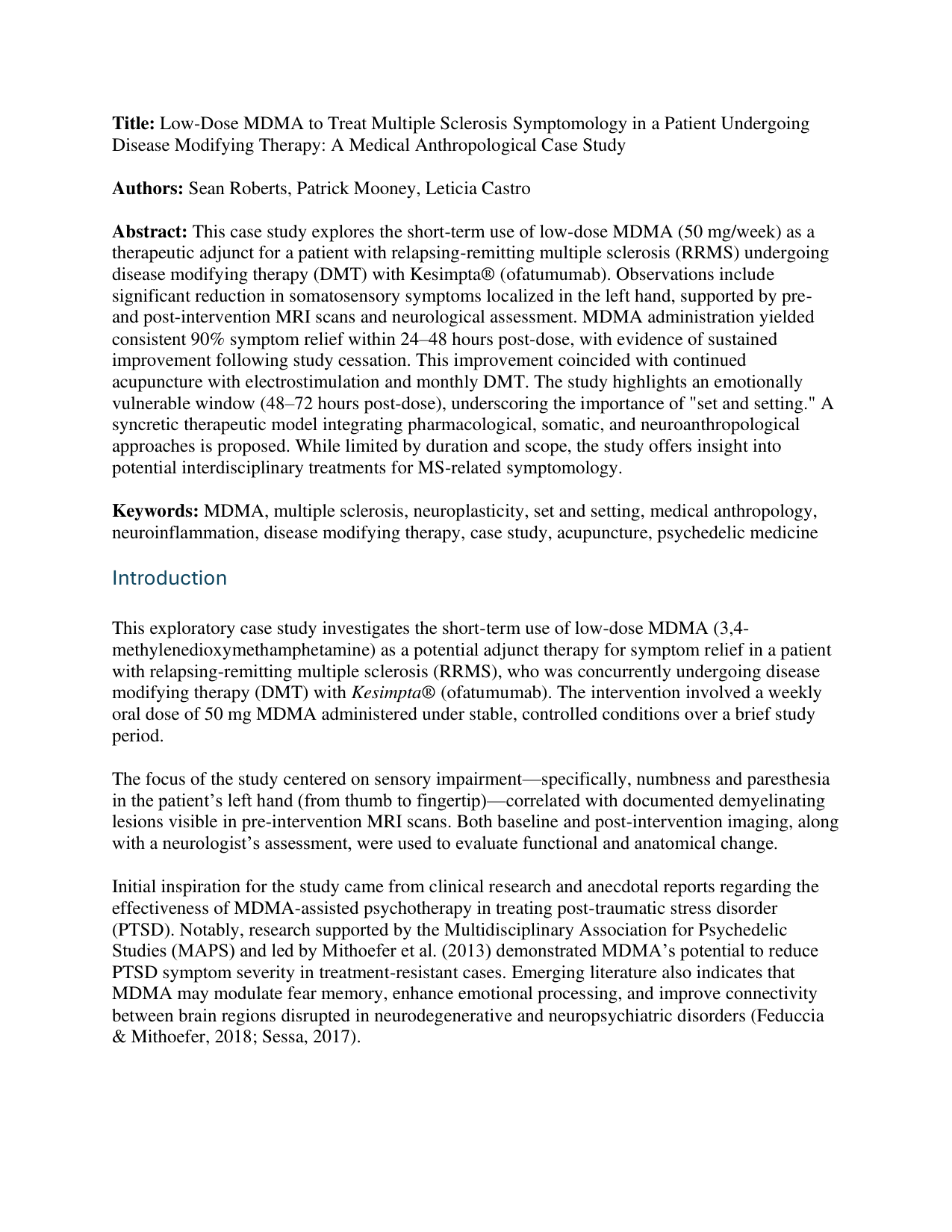
The viewer is designed for direct in-page reading. Ordinary open/download calls to action are not used on the public evidence record. Qualified reviewers may receive controlled access to source files through the data room.
Interpretation ledger
The evidence ledger prevents the manuscript from being represented as direct efficacy evidence for NovusClarus.
| Statement | Classification | Support | Limitation | Next test |
|---|---|---|---|---|
| Short-term sensory relief was reported after weekly 50 mg MDMA. | Case observation | Self-report and symptom maps | Single subject; no blinding or comparator | Prospective standardized sensory outcomes |
| MDMA may facilitate neuroplastic adaptation. | Proposed mechanism | External neuroplasticity literature | Mechanism not demonstrated in this case | Biomarker and imaging strategy |
| 50 mg MDMA + 500 mg acetaminophen may improve MS symptomology. | Open question | Combination rationale and case context | Fixed combination not directly tested | Four-arm randomized component study |
Evidence record
Working manuscript · unfinished · unpublished · not peer reviewed.
Authors: Sean Roberts, Patrick Mooney, Leticia Castro
Design: single subject
Viewer: inline / view only
Interpretation
Subjective short-term relief after weekly 50 mg MDMA within a multimodal care context.
Requires prospective randomized component analysis.