Classical
Pressure, bubble dynamics, cavity collapse, cavitation, surface tension, viscosity, oscillation, and fluid behavior.
Governing physical model.Stella Nova Research Area
Nested aqueous systems, structured boundaries, low-density cores, and speculative coherence pathways.
From water to boundary to viability
The Structured Water, Cavitation, and Coherence Models research area examines whether nested aqueous systems can be modeled as physically viable before any speculative function is assigned to them. The central object is the water-void boundary: the region where external water, interfacial behavior, pressure, and low-density space meet.
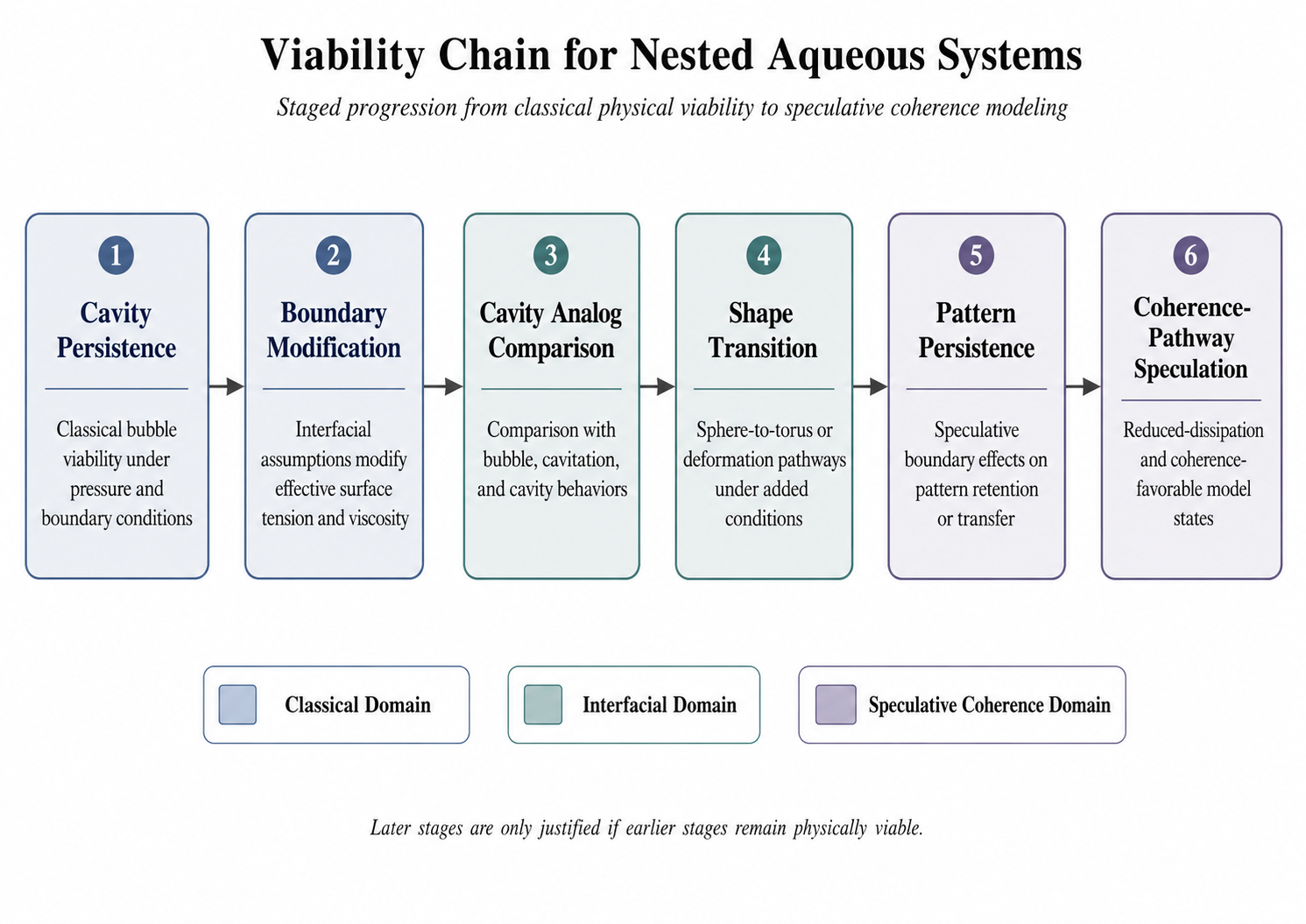
This research area begins with classical cavity dynamics. It then introduces boundary-layer assumptions, cavitation analogs, shape-transition modeling, pattern-persistence hypotheses, and finally speculative coherence-pathway questions.
Methodological Note
Pressure, bubble dynamics, cavity collapse, cavitation, surface tension, viscosity, oscillation, and fluid behavior.
Governing physical model.Structured water, interfacial ordering, exclusion-zone assumptions, charge separation, shell behavior, and field stabilization.
Boundary-condition hypothesis.Noise reduction, pattern persistence, reduced dissipation, speculative transmission pathways, and objective-reduction-adjacent hypotheses.
Speculative overlay.Layer 1 contains the governing physical models. Layer 2 contains boundary-condition hypotheses. Layer 3 contains speculative overlays and is only entered after earlier viability constraints are satisfied.
Master Paper
Version 0.1 — Draft Research Framework
This master paper defines the staged research architecture for the Structured Water, Cavitation, and Coherence Models suite. It separates classical bubble dynamics, structured-boundary hypotheses, cavitation analogs, field-pattern speculation, and coherence-pathway modeling into distinct methodological domains.
The framework does not claim that structured water stabilizes cavities, that water stores information, or that objective reduction occurs in aqueous systems. It defines the model sequence required to ask those questions responsibly.
Viability Chain
Research Instruments
Nested Sphere Viability Model
Tests whether a spherical gas/vapor core can remain stable, metastable, oscillatory, or collapsing under submerged pressure and boundary conditions.
Structured Water Boundary Model
Explores whether structured, ordered, exclusion-zone, or interfacial-water assumptions materially alter boundary stability.
Cavitation and Bubble Dynamics Model
Compares modeled nested aqueous structures against known gas bubbles, vapor bubbles, cavitation events, oscillating cavities, and collapse behaviors.
Sphere-to-Torus Transition Model
Tests whether a stable or metastable spherical structure transitions toward toroidal geometry under flow, shear, rotation, or field gradients.
Water-Pattern Transfer Hypothesis Model
Treats water-memory and field-pattern claims as speculative model parameters and tests pattern persistence against baseline degradation.
Minimal-Dissipation / Objective-Reduction Pathway Visualizer
Synthesizes earlier viable model states and asks whether they produce reduced-noise or reduced-dissipation conditions worthy of further theoretical review.
Citation
Roberts, Sean. 2026. The Water-Void Boundary: Structured Water, Cavitation, and Coherence Pathways in Nested Aqueous Systems. Version 0.1. Stella Nova Education, Structured Water, Cavitation, and Coherence Models Research Area.
Cite the version used, as equations, assumptions, coefficients, and instrument specifications may change in later releases.
Version Notes
Initial master-paper release defining the Structured Water, Cavitation, and Coherence Models research area.
Scholarly Questions and Additions
Use this no-database local annotation log for source recommendations, mathematical corrections, model assumptions, experimental suggestions, theoretical objections, and interface issues.